

What Does Viksit Bharat Mean for a City Like Pune?
Viksit Bharat is the government's plan for India to become a fully developed nation by 2047. That year marks 100 years of independence. The plan covers roads, income levels, and quality of daily life. Well planned cities sit at the heart of it.
For a city, this is not just about new metro lines or IT parks. It also means old parts of the city get a real upgrade. They should not be left behind while new suburbs grow around them. A city cannot call itself developed if its outer edge has shiny new towers. Not while its older buildings still have weak walls, poor drainage, and no parking.
Aatmanirbharta, or self reliance, fits in here too, at a local level. PM Modi used the word mainly for defence and manufacturing. But the idea behind it is simple. Solve your own problem instead of waiting for someone else to fix it. That is exactly what many Pune housing societies are doing now. Instead of waiting years for outside help, they hire the right experts and rebuild on their own terms.
Why Does Urban Development in Pune Look Different Today?
Pune has grown fast over the last two decades. IT parks, colleges, and a steady flow of new residents pushed the city outward. Many areas on today's map barely existed twenty years back. But land at the edge of any city runs out eventually. Maharashtra's planners now want cities to grow smarter, not just wider.
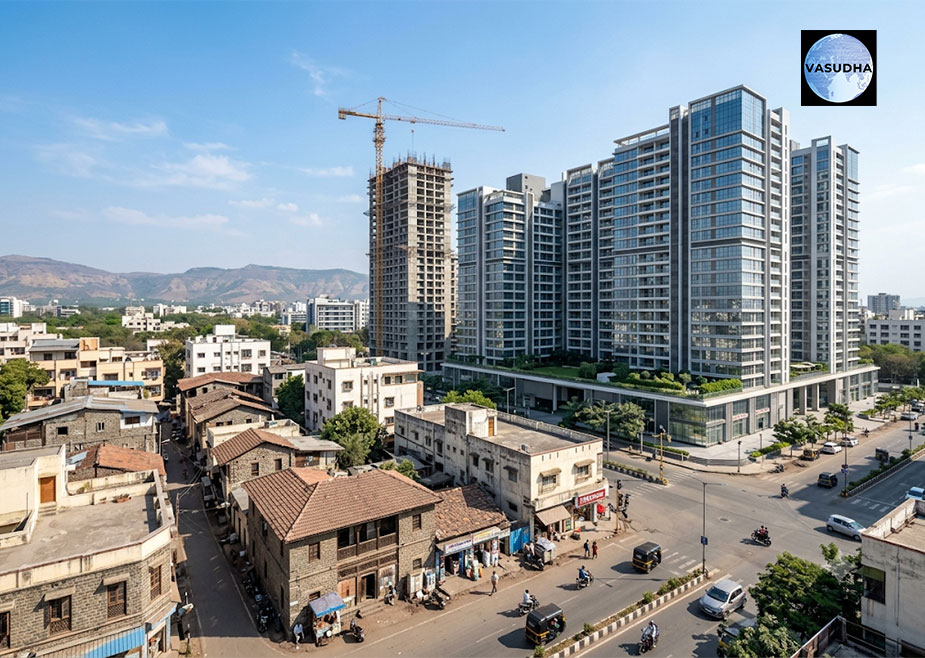
This is where redevelopment steps in. Instead of only building new residential projects on open land at the edges, Pune is rebuilding within its own footprint. Old, low rise buildings from the 1970s, 80s, and 90s are coming down. Taller, better planned buildings are going up in their place, on the same plot. This shift, building upward on land the city already has, is a big part of what smart urban development in Pune looks like today.
What Is Housing Society Redevelopment?
Housing society redevelopment is simple to explain in one line. A cooperative housing society tears down its old building, and builds a new one, usually with a developer's help. In return, members get a bigger, more modern flat. The developer gets the right to build and sell extra flats on the same land.
That one line hides a longer process, though. It comes with several stages, each with its own approvals and paperwork. Here is what it usually looks like for a society in Pune.
How Does the Redevelopment Process Work?
- The society votes. Redevelopment starts with a Special General Body Meeting. Under current norms, a clear majority of members, often around three fourths, must agree in writing.
- A Project Management Consultant, or PMC, is hired. Most Pune societies bring in a PMC before they talk to any developer. A PMC understands construction, law, and negotiation. Their job is to protect the society, not the builder.
- Builders submit proposals. The society puts out a tender. It lists the plot size, the number of flats, and what members want in return, things like larger carpet area and a corpus fund.
- The society picks a developer. A good PMC compares more than just flat size. Track record, financial strength, and past delivery timelines all matter.
- Agreements get signed. A Letter of Intent comes first. Then a full Redevelopment Agreement follows, covering flat size, rent during construction, deadlines, and penalty terms for delays.
- Approvals come through. This includes building permission from Pune Municipal Corporation, various no objection certificates, and RERA registration.
- Construction happens. Members move out on agreed rent, the old building comes down, and the new one goes up. For a mid sized society, this usually takes two to four years.
- Members get possession. Once the occupation certificate arrives, members move into their new flats. The property is then formally handed back to the society.
Key takeaway: redevelopment is not one deal signed on one day. It is an eight stage journey, from consent to possession. Skip a stage, and problems tend to show up later.
What Changed Under the Newer Redevelopment Rules?
Maharashtra has cleared up several redevelopment rules in recent times. These changes are worth knowing.
- Consent rules are clearer now, generally around 51 percent for standard redevelopment, and higher for buildings marked unsafe.
- Every member's Redevelopment Agreement must now list exact, RERA compliant carpet area. No more guesswork.
- Societies must get a rehabilitation area worth at least 125 percent of its market value.
- Temporary housing support during construction is now a standard expectation, not a favour.
Redevelopment still carries some risk, but committees today hold far more protection on paper than they did ten years back.
A Realistic Example
Picture an old society in a well located Pune area, where flats were once worth around 20 to 23 lakh rupees. Cases like this are common in Pune's property records. After redevelopment, with modern layouts and updated safety features, those same flats often sell for 60 lakh rupees or more. That is not a guarantee for every project, but it explains why so many societies that once resisted redevelopment are now asking for it.
Redevelopment as a Small Act of Aatmanirbharta
A society that redevelops itself is doing something worth noticing. It hires its own PMC, negotiates its own terms, and manages its own timeline. It is taking charge of its own future, instead of waiting for someone else to decide it. Multiply that across hundreds of societies in Pune, and you get a city rebuilding itself from within, which is what urban development in a growing Indian city should look like.
Local, experienced developers play a role here too. Vasudha Realty has been building in Pune for over two decades, including premium residential projects in NIBM Road. That kind of local experience matters, with Pune's approvals, its weather, and its buyers. A society will work with its chosen partner for years, so that experience counts.
What Should Homeowners and Committees Check Before Saying Yes?
Whether your society is shortlisting a builder, or you are comparing some of the best real estate developers in Pune for your own next home, a few checks apply either way.
- Ask for the developer's last three finished projects. Visit them if you can.
- Get every promise in writing, flat size, amenities, corpus fund, and rent, not just spoken in a meeting.
- Hire your own PMC and your own lawyer. Do not use one the developer suggests.
- Confirm RERA registration before you sign anything.
- Read the delay penalty clause closely, before you sign.
Where Is Pune's Real Estate Market Headed?
Redevelopment is changing demand patterns across the city. Areas with good roads and schools, but older buildings, are seeing fresh interest. NIBM Road is a good example, a corridor with strong transport links now seeing new and ongoing residential projects in Pune, right alongside older societies going through their own redevelopment.
Buyers today track two things at once, upcoming residential projects in Pune built fresh on open land, and redeveloped societies offering modern flats in older, established areas. Both are raising the bar for new residential projects in Pune, better build quality, clean paperwork, and long term value over a lower price tag.
In Closing
Viksit Bharat is a big, national goal. But it gets built one street, one society, and one building at a time. When a housing society chooses to rebuild itself, instead of waiting for change to arrive, that is Aatmanirbharta in its most everyday form.
If your society is exploring redevelopment, it helps to work with people who know both the paperwork and the neighbourhood well. The same goes if you are simply looking at residential projects in Pune for your next home. Vasudha Realty has spent over twenty years building homes across Pune, including along NIBM Road. That experience shows in what a smooth redevelopment, or a new project, truly needs.
FAQ
It means tearing down an old building and putting up a new one, on the same land. A developer usually does the work. In return, members get a bigger, newer flat.
Most projects need written yes votes from a clear majority of members, often around 51 percent. Unsafe buildings often need a bigger majority, close to two thirds.
A PMC, or Project Management Consultant, works for the society, not the builder. They check builder offers, review the fine print, and guard the society's interest at every step.
Construction alone often takes two to four years for a mid sized society. Add the time for approvals and agreements before that, and the full process can run longer.
In most cases, yes. Members usually get more space than their old flat, plus new amenities. The exact terms depend on what the society agrees to in writing.
Yes, for projects above a certain size. RERA rules cover flat size disclosure, project deadlines, and protection for both buyers and existing members.
NIBM Road already has good roads, schools, and access to IT hubs nearby. That draws both new luxury residential projects in Pune and older societies keen to redevelop instead of moving out.