

Union Budget 2026-2027: What it means for India's Real Estate Sector
The Union Budget 2026, presented by Finance Minister Nirmala Sitharaman, has set the tone for India’s growth trajectory over the next few years. While it doesn’t offer immediate, sector-specific relief for real estate, the Budget surely emphasizes some specific factors like infrastructure, urban expansion, manufacturing, and digital capacity. All of these certainly have significant implications regarding the property market. Moreover, the budget renews its focus on tier-2 and tier-3 cities along with industrial corridors and data centres. Additionally ,the Budget signals long-term opportunities for residential, commercial, and industrial real estate alike.
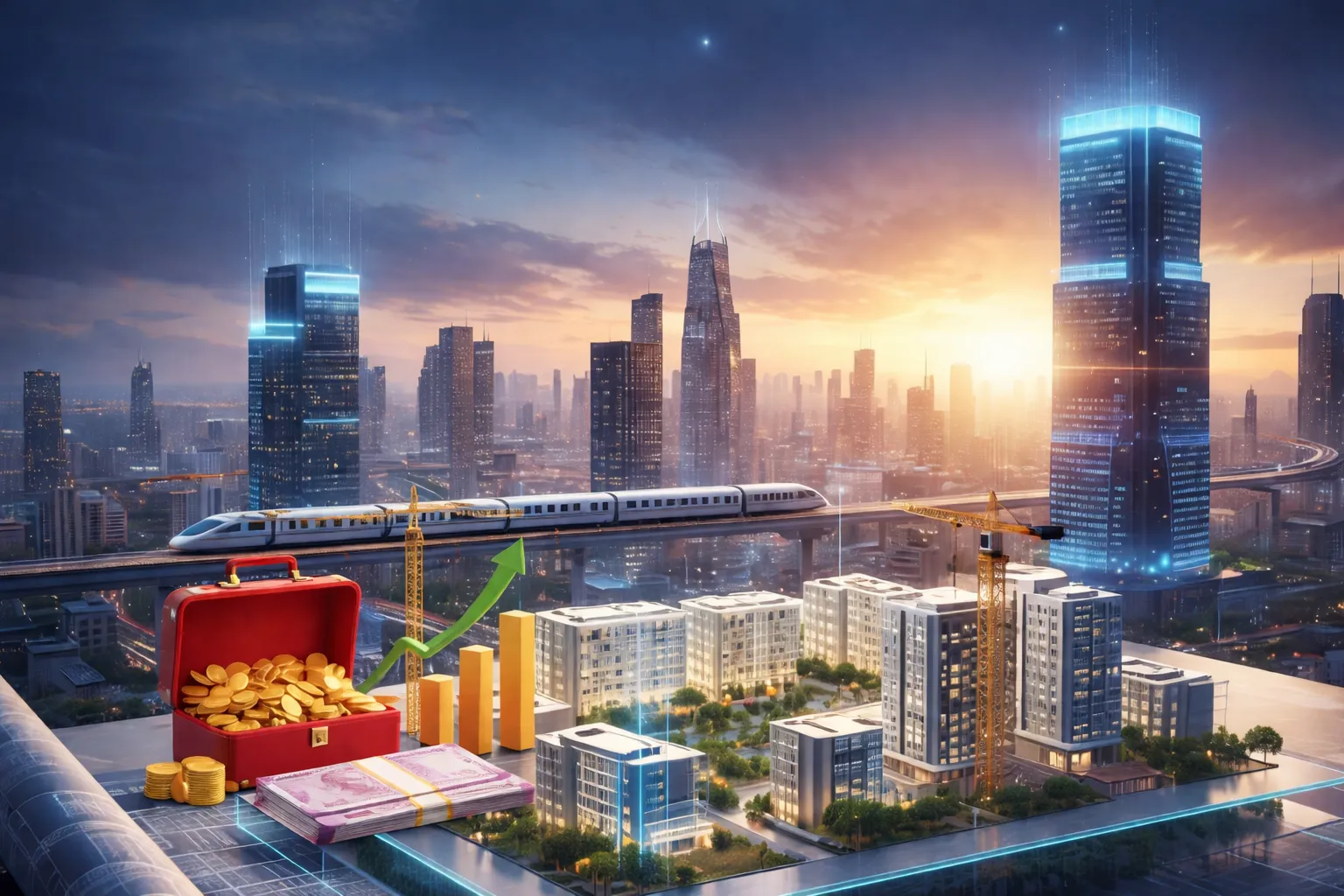
Infrastructure-Led Growth
In the newly released Budget 2026 one of the most prominent themes that we are able to detect is the push for efficient and sustainable infrastructure.
With a capital expenditure allocation of ₹12.2 lakh crore for FY27, the Budget highlights the focus on long-term asset creation. For the real estate sector, we can say it's good news as infrastructure investments are bound to improve land viability, boost project feasibility, and positively influence absorption cycles.
Urban expansion is expected along high-speed rail corridors, dedicated freight corridors, inland waterways, and newly developed urban clusters. These developments can reshape demand for both residential properties and commercial properties. Buyers are likely to see enhanced connectivity, and developers can explore new corridors for upcoming projects.
The infrastructure push proposed in the budget proves beneficial to Tier-2 and Tier-3 cities. With the increase in accessibility and better quality of life, the property demand in these cities is expected to shift beyond the now oversaturated Tier-1 markets.
Tier-2 and Tier-3 Cities classified as the new growth drivers
The most important outcome of Budget 2026 is the decentralisation of urban demand. With ₹ 5,000 crore allocated over five years per City Economic Region (CER), the government is aiming to foster infrastructure growth in tier-2, tier-3 cities, and even temple towns.
With the new emerging and developing cities, they are certain to present attractive opportunities, especially with regards to the residential and commercial real estate.
Moreover, corporate offices, start-ups, logistics hubs, and mixed-use developments are expected to expand in these locations, which are in turn supported by improving infrastructure, lower real estate costs, and emerging talent pools.
According to the real estate experts, this dynamic shift will work wonders to ease pressure on over-saturated metros. This will be helpful in creating more balanced urban growth and generating new investment avenues. As per the experts, it becomes thus most significant for the developers and investors to closely monitor these cities for residential and commercial opportunities.
Manufacturing and Industrial Real Estate Gains Momentum
Budget 2026 reinforces India’s manufacturing and industrial strategy, with special focus on sectors such as biopharma, electronics, textiles, rare earths, and container manufacturing. These sectors have strong real estate linkages as they demand industrial parks, R&D centres, logistics hubs, and specialized commercial spaces.
For industrial real estate, the government’s allocation for textile and chemical parks and rail freight corridors is sure to increase demand for well-planned industrial and warehouse facilities. Moreover, this will also accelerate the development of university townships, research institutions, and skill centres, driving further residential demand in these regions.
Obviously, investors and developers in industrial and logistics real estate are likely to benefit from these structural measures with an aim to balance long term growth across all regions.
India as the next Data Hub Centre
One of the significant announcements made in the recently released Budget 2026 is the tax holiday for foreign cloud service providers till 2047. This move strategically positions India as a new global data centre hub and is expected to attract substantial foreign investment.
Data centres require specialized commercial real estate with robust power and water infrastructure, high-security standards, and connectivity. With foreign players incentivized to build large-scale data facilities in India, demand for suitable real estate is expected to rise in both tier-1 and select tier-2 cities like Jaipur, Vijayawada, and Pune.
This development will enhance and uplift commercial real estate prospects and also indirectly support residential growth as skilled workers are bound to relocate to these data centre hubs with an increase in employment opportunities.
REITs and Asset Monetisation
Another key feature of the Union Budget 2026 is the proposal to monetize central public sector enterprise (CPSE) assets through dedicated REITs. This move is expected to unlock nearly ₹10 lakh crore of value across railways, ports, power transmission, telecom towers, and other government properties.
REITs provide a stable, income-generating asset class, making them attractive for both institutional and retail investors. REITs can improve transparency, liquidity, and long-term market confidence relatively by pooling together government and real estate holdings in prime locations.
Investors looking to diversify into Indian real estate can now explore these new avenues, which may provide more predictable returns compared to traditional property investment.
Tourism, Education, and Alternative Real Estate
Budget 2026 also prioritizes tourism, education, and medical value tourism, which indirectly are responsible for boosting demand for hospitality and residential assets. It is predicted that the development of iconic sites, temple towns and education-focused towns and cities can drive real estate demand in the areas.
Hotels, guest houses, student accommodations, and serviced apartments are likely to see higher interest in these growth corridors. By linking infrastructure investment with skill development and urban planning, the government aims to foster a conducive environment for both real estate expansion and long-term socio-economic development.
Affordable Housing
In spite of asking for multiple measures to stimulate real estate, affordable housing has largely remained unaddressed for quite a while now. As per the reports, it has been seen that the residential sales in this particular sector have significantly declined from over 38% in 2019 to around 18% in 2025.
The absence of direct fiscal incentives, interest subsidies, or high-impact measures for developers and buyers limits growth in this crucial segment. Considering the importance of affordable housing for inclusive urban expansion, this gap represents a missed opportunity for policymakers to strengthen demand in the residential market.
Tax Updates
Several tax-related announcements in Budget 2026 have implications for property developers and buyers:
- Interest on prior borrowings: Deduction remains capped at ₹2 lakh annually for self-occupied property.
- TDS simplification: Residents purchasing property from non-resident sellers can deduct TDS using PAN, without requiring TAN.
- Capital gains & buy-back taxes: Revisions may impact real estate investors with shareholdings in realty firms.
MAT reduction: Minimum Alternate Tax for domestic companies under the old regime reduces from 15% to 14%.
These updates provide clarity for investors, promote compliance, and influence strategic decisions in property acquisition and development.
In short, the Union Budget 2026 does not speak about immediate relief for homebuyers or developers. Instead, it focuses on structural support, long-term growth, and sustainability in the real estate ecosystem.
By emphasizing infrastructure, tier-2 and tier-3 city development, manufacturing, data centres, REITs, and alternative assets like tourism and education townships, the Budget overall skillfully lays a foundation for stable, inclusive growth.
While affordable housing and direct fiscal incentives for buyers remain a gap, the broader policy framework signals confidence and continuity, creating opportunities for investors, developers, and urban planners across India.
The real estate sector, therefore, can look forward to infrastructure-driven growth, emerging city markets, and new investment avenues, positioning India as a robust destination for property investment over the next decade.